
No permit needed
Ask what the rate includes, not what the labour costs
Delivery, hoisting, installation and adjustment are all inside a proper rate. A quote that separates them later is repricing the same work.
hdb.gov.sg · read 2026-08-31
Carpentry is priced per foot run, and a rate means nothing without the carcass material behind it. Documented carpentry lines have run from around S$1,500 on small jobs.
Carpentry Singapore quotes are priced per foot run, meaning one linear foot of built carpentry at a stated depth, height and carcass material. Without those three things a rate is not comparable to any other rate. Documented small jobs have run from around S$1,500.
01 PERMIT
Hacking always
needs one
All demolition and hacking of walls, partial or complete, needs HDB’s prior written approval before anything starts.
hdb.gov.sg · read 2026-08-31
02 HOURS
Mon to Fri
9am to 5pm
Restricted works only. General works such as painting and screed run Monday to Saturday until 6pm.
hdb.gov.sg · read 2026-08-31
03 DEADLINE
3 months for
a new block
From the date the permit is granted. Existing blocks get 1 month.
hdb.gov.sg · read 2026-08-31
Built-in storage and surfaces: wardrobes, kitchen cabinets, a television console, a shoe cabinet, sometimes a study desk or a feature wall. Made to the flat rather than bought for it.
It is normally the largest single line in an HDB renovation, which makes it the line most worth understanding before you compare any two quotes.
Carpentry Singapore buyers are quoted this way whether they approach a workshop directly or go through a contractor. The vocabulary is the same, which means the comparison method is portable.
There is no single answer, because carpentry is sold by quantity rather than by job. What exists is a rate, a run length and a specification, and the three multiply out.
| Item | Reported range |
|---|---|
| 3-room BTO | S$25k to 50k |
| 4-room BTO | S$51k to 62k |
| 5-room BTO | S$40k to 115k |
Whole-project bands with their sources and dates. Carpentry is normally the largest single line inside these totals.
Sources interiordiary.com.sg 2026-08-31qanvast.com 2026-08-31moneysmart.sg 2026-08-31
Use the whole-project bands as context rather than as a carpentry price. A carpentry quote is only meaningful once you know how many feet it covers.
The same caution applies to any renovation cost Singapore guide that quotes a single carpentry figure. Ask what run length it assumed before you use it for anything.
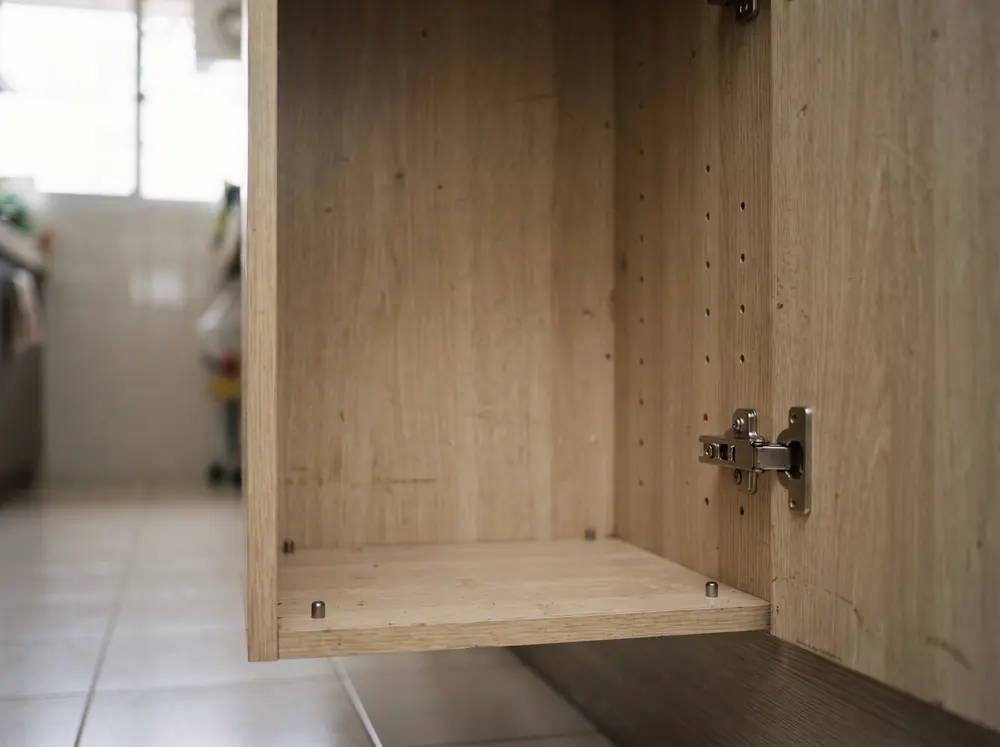
A foot run is one linear foot of built carpentry. On its own it says nothing, because a foot of shallow overhead cabinet and a foot of full-height wardrobe are different objects at the same length.
Ask for all three beside every rate. That single request turns two incomparable quotes into two comparable ones, and it costs you nothing but an email.
Whoever you find has to be on one register. Any firm doing carpentry inside an HDB flat must appear in the Housing & Development Board’s Directory of Renovation Contractors.
All three routes are legitimate and all three are bound by the same rule. Check the register before paying a deposit, whichever one you choose.
Firms advertising carpentry services Singapore-wide are covered by it too. So is any renovation contractor Singapore homeowners engage for a full fit-out, and so is an interior design firm subcontracting the work.
In practice you are rarely quoted labour separately. The foot-run rate bundles material, fabrication, delivery and installation into one number.
Delivery, hoisting, installation and adjustment are all inside a proper rate. A quote that separates them later is repricing the same work.
Five things. A carpentry line missing any of them cannot be compared to the line beside it, and the cheaper one is usually just the one that left more out.
A provisional sum is acceptable for something genuinely unknown. It is not acceptable as a substitute for measuring the wall in front of you.
Put all five on the renovation quotation itself rather than in a chat thread. An itemised quote is the document you will be holding if anything is disputed later.

Carpentry itself is rarely the regulated part. What is regulated is anything it needs done to the flat first: hacking, wall removal, and works that touch structure.
A carpentry design that assumes a wall is coming out is a design contingent on approval nobody has yet. Confirm the classification before the drawings are agreed.
Installation is general renovation works, so Monday to Saturday, 9am to 6pm. Any hacking that precedes it is restricted works, Monday to Friday, 9am to 5pm only.
Sources MyNiceHome by HDB 2026-08-31
Those restricted works gate this trade, because hacking has to finish before installation can start. Any electrical alteration behind a unit needs a worker holding an Energy Market Authority licence as well.
Three months in a newly completed block, one month in an existing one, counted from the day the HDB renovation permit is granted.
Tell us the flat type and when you collect keys. You get a scope discussion and an indicative cost band within one working day.
or email hello@btorenovation.sg

Late, and dependent on everything before it. Wet works and first fix have to be complete before a single unit is delivered.
That dependency is why carpentry absorbs upstream delay. When tiling slips a week, this is the trade that loses it.
Build the renovation timeline with that in mind. If you kept the Optional Component Scheme flooring the sequence shortens, because there is no floor to remove before anything else can begin.
The carcass and the hardware. Everything else is visible, comparable and much less consequential than it looks in a showroom.
Hinges and runners are the other half. They are the components you operate several times a day, and they are the components that fail first when a rate has been cut.
Ask for both to be named on the quote. A brand you can look up is a specification; a phrase like quality hardware is a description of nothing at all.
Lead time is weeks in a workshop. Install time is days in the flat. A schedule that quotes only the second number is describing a fraction of the wait.
Ask for both as separate figures, and ask when fabrication actually starts. It starts after the measure and after the drawings are signed, not after the deposit clears.
Slippage upstream eats the fabrication window rather than the installation window, which is why a late tiling job quietly becomes a late carpentry job three weeks later.
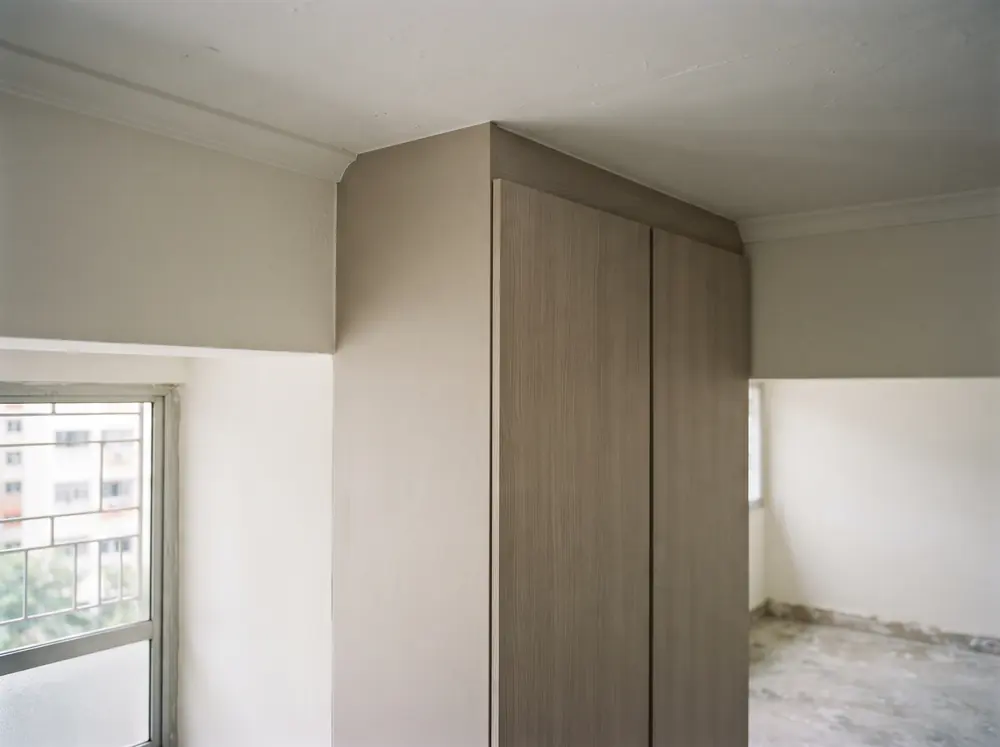
Built work is made to the flat as it actually is, not to the floor plan. Walls are rarely exactly where the drawing says, and a few millimetres over three metres is a visible gap.
This is also why a carpentry quote given before key collection is an estimate. It can be a good estimate, and it is not a price.
Almost nothing goes wrong on installation day. The failures in this trade are patient, and they surface in year two or three.
All three trace back to a specification nobody wrote down. That is the whole argument for insisting on one before you sign.

Get the defects liability period and any workmanship warranty in writing, with what each covers and for how long.
Repairing a wall after a unit is removed or repositioned takes materials and labour. If it is not a named line, it was not priced.

Carpentry depends on wet works, first fix and floor level. It is depended on by nothing, which is why it goes last and why it absorbs every delay upstream.
We walk the flat after key collection, measure every run, and write down what you want changed and what HDB will let you change.
Your contractor files the electronic application. Wall demolition needs the flat’s floor plan submitted with it.
Demolition, tiling and anything touching the bathroom happen first, inside the restricted-hours window.
Kitchen and wardrobe carpentry is fabricated to a fixed specification, then installed, then painted.
Tie payments to fabrication and installation stages you can verify, never to dates.
A carpenter asking for most of the money before fabrication is asking you to fund the workshop. That may be normal for them and it is still a risk sitting with you.
Tell us the flat type and when you collect keys. You get a scope discussion and an indicative cost band within one working day.
or email hello@btorenovation.sg
Normalise the specification before you compare a single number. Match run length, depth, height, carcass and hardware, then look at the totals.
Nine times out of ten the gap shrinks to something small and explicable. The tenth time you have found a real difference worth paying for or walking away from.
The hdb renovation guidelines do not govern how carpentry is priced, so this discipline is entirely on you. Nobody is checking the quote except the person paying it.
Carpentry cannot correct a bad layout, a floor that is out of level or a wall that should have come down and did not.
It can hide some of those things, expensively and temporarily. Fixing them upstream is always cheaper than building around them.
Installation is noisy in short bursts rather than continuously, and it produces less dust than any wet trade. It is the easiest stage to live beside.
Neighbours within two units still get written notice at least five days before works begin, and the Notice of Renovation stays displayed outside the flat throughout.
Every number carries a named publisher and its publication date. Regulatory claims cite HDB directly with the date the page was read.
Rates observed in the market are treated as observations with a date, never as a benchmark. The BTO renovation package page explains how the same figures behave once they are bundled.
No licence number, no accreditation, no review, no rating and no photograph captioned as our own completed project. None exists for BTO Renovation SG.
Every image here is a generated illustration and says so. Check any firm, including us, against the register described above before you pay anything.
Tell us the flat type, when you collect keys, and roughly which walls you want built into. Photographs of the empty flat help more than you would expect.
You get a reply within one working day with a scope discussion and an indicative band. A firm carpentry number waits for the site measure, because that is what the trade requires. See ideas that do not need carpentry.
Checked against primary sources · updated 2026-09-01